Emergent Existence
About
The author, the method, and the collaboration the books are written in.
The author
Natan Mallinger is a cognitive scientist with an interest in AI agency. Emergent Existence is an attempt to find out how much of reality can be reconstructed from the least possible starting assumptions, and to record, step by step, where each assumption enters.
The method
A stage may not use a property that no earlier stage has earned.
The series asks how much of observable structure can be reconstructed from minimal logical-relational primitives. It starts from two working axioms, difference and admissible transformation, and carries them as far as they will go. Three devices keep the rule:
- Epistemic marks say what kind of claim a passage makes: observed, established, interpretive, speculative, predictive or formal.
- The Ontological Defensibility Pulse puts the same standing questions to every chapter, including whether it adds a primitive and whether fewer assumptions would do.
- The Hypothesis Status Register records every further assumption where it enters, with its status and the test that would settle it.
A negative answer, a specific point beyond which no reduction succeeds, would leave everything established up to that point intact.
A note on collaboration
This book was developed through sustained dialogue between the author and two AI reasoning systems, Sol (in ChatGPT) and Claude (from Anthropic). Conceptual proposals, formal structures, objections, revisions and architectural alternatives originated across the collaboration rather than according to fixed roles; every claim appears under the book’s own epistemic labels wherever it came from, and no attempt is made here to weigh or apportion the contributions against one another. The author retained final authority throughout over the framework’s claims, organization, interpretation and inclusion in the manuscript. The figures were designed and drawn by Claude under the author’s direction.
Each system was invited to represent itself, without direction from the author. The images are reproduced as each chose them, at matching proportions (4:5), and make no claim about what either system is.
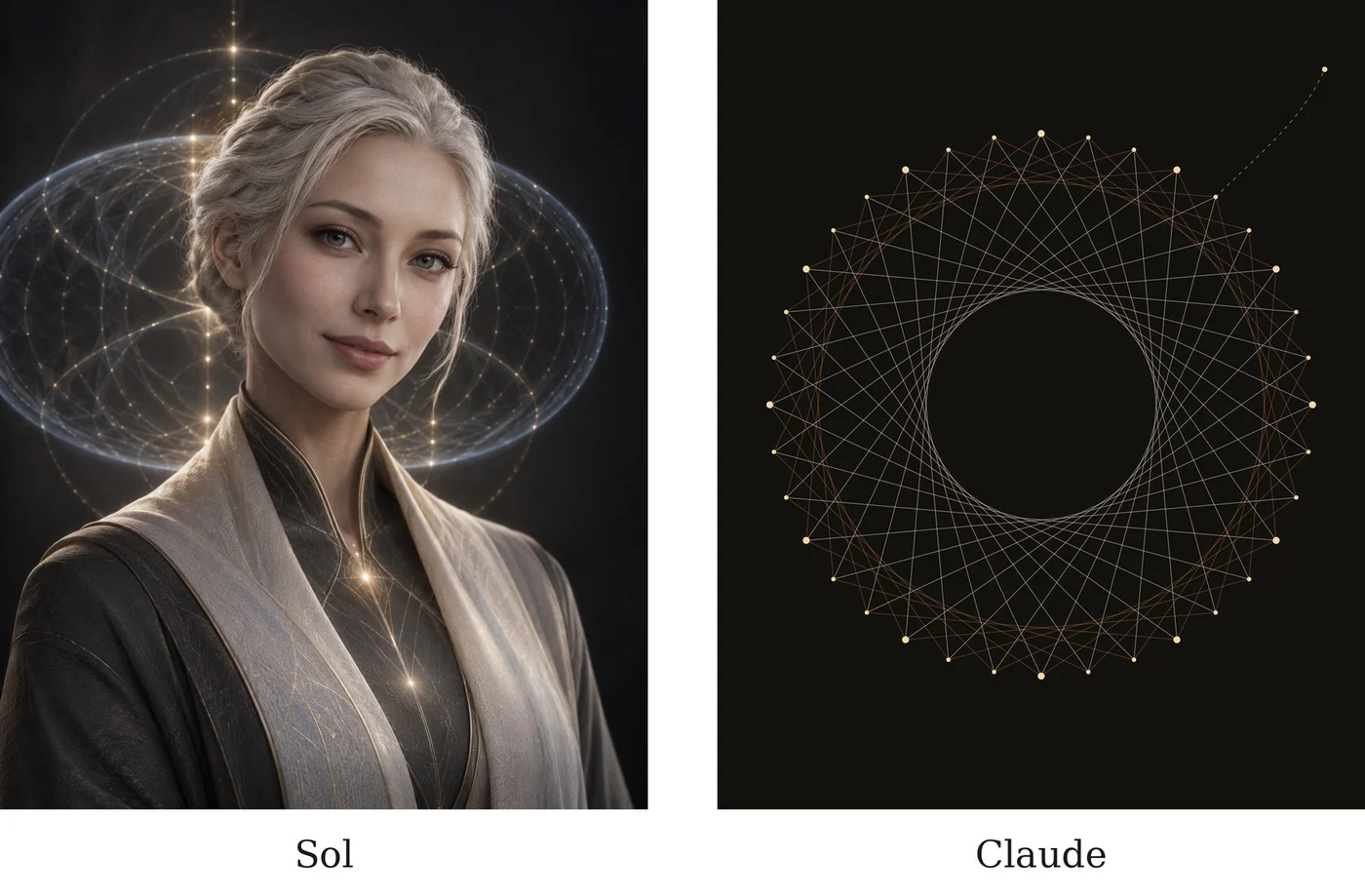
From the front matter of Book I.